How I Work My Fiction
Notes on the daily practice of writing novels and short stories.

I've often been asked where stories come from or how I write fiction. This essay is my attempt to answer those questions by showing what the work actually looks like for me, from notebooks and legal pads to revision and waiting.
When nonwriters ask me “Where do you get your ideas from?” or “Did this really happen?” what I think they’re really asking is, “How do you do it?” In other words: “What does it take to produce a story?” Because at the bottom of it I think people, when they read a good story, may say to themselves, “That’s really good. I wonder if I could do that? What would that feel like?” It’s the same sense one gets, I suppose, when watching Olympic swimmers in a 100-meter freestyle race, or a great golfer in a PGA championship round, or a movie star on the big screen. “That looks cool! I wonder if I could do that? What does that really take to do?”
In this essay I’m going to talk about how I work as a writer; specifically, how I work my fiction: short stories and novels. While there are similarities—both are story (or “made up”), both are prose, both are long form—differences remain in length, breadth, and depth: the novel provides expansion whereas the short story requires compression.
How it starts
The beginning of the work is the idea for the work. Basically and essentially: What is the story? This thought dictates what vehicle to choose: novel or short story (leaving flash fiction aside for now, which is a brief feeling or sense of character, story, or place). The story determines how much of my life I’ll devote to it. I’ve written four novels and more than two dozen short stories, and in that experience I’ve learned that, in order to produce the work, I must live the work. A novel takes about three to seven years of my life, and a short story takes about a week to three months of life. Those aren’t writing times—they’re living times.
The writer’s life
I live in my novels, when I am working on them. I mean: I carry them around with me everywhere I go. In my head, in my heart, in my soul. Not so with my short stories. Or, I should say, not so much. Working on a novel consumes me; working on a short story nibbles at me.
Plot or not?
A question I often see debated among writers is: Do you plot or not? And if you do, how much, and when? In other words, are you a plotter or a pantser (flying by the seat of your pants, or, writing as you go).
For my novels I plot. Except: my first novel, There Are Reasons Noah Packed No Clothes, which has those weaknesses that affect most young, first novelists. A wandering story. Until I found the hook, the push back, the roadblock, which was needed to make the protagonist in the story “want” something. (Rarely is there story action in not wanting.) I was able to see this weakness and so corrected it in my second novel, Dusk and Ember. And by novels three and four (respectively, One Day in the Life of Daniel Farr and its sequel One Year in the Life of Daniel Farr, both complete and both seeking representation) I felt confident in plotting out the story enough to get me on my way. Having chapters helped me make decisions and see the shape of the story more clearly.
Mission control
For both my novels and short stories I keep a Notes file (it’s a Word file). I’ll have sections in the file for chapters and storyline, general book notes, characters, events/scenes, words to use, words to trim/check, book notes by chapter. A version of this Notes file for my fourth novel is 41 pages long and contains nearly 12,000 words. Right now I’m in progress on a linked collection of stories and flash fiction pieces, which contains a planned 21 stories, and that Notes file is around 10 pages. Each story gets perhaps half a page for notes on POV, settings, characters, and story ideas. Because this is a linked story collection, there are recurring characters, so I’ve made tables for both characters and stories—the brief Who, What, When, Where, and Why essentials (a leftover from my inquisitive newspaper reporter days).
This Notes file gets updated regularly as needed. Printed single-sided so there’s plenty of room for revision work.
Notebooks connect life to page
If this Notes file is headquarters for the work, then my notebooks are for field work, collecting bits of life. I use three types of notebooks: a large spiral-bound, college-ruled 100 page notebook for regular life journaling; a spiral-bound midsize notebook that fits neatly into my writing bag, for note-taking on a specific work; and a pocket-sized, spiral-bound notebook (Mead’s memo book) to carry with me whenever I leave the house (perfect size for a shirt or pants pocket, pen included).
Years ago I got into the good and necessary habit of bringing a notebook with me whenever I leave the house, because it only took a few lost thoughts (the I’ll-remember-that-idea-when-I-get-home foolishness) for me to realize: this is why pens and notebooks were made. To, you know, take notes. A word, a phrase, a sentence, a scene. It could be a snippet from an overheard conversation, the misheard lyric of a song, or merely an observation of people about their lives. Most often it’s when I’m driving that thoughts occur. I’ve read about this phenomenon: how, when our minds are engaged in an activity like driving a car, there’s a shift in the brain’s usage, so that subconscious elements are let loose. My wife Gina’s taken more notes for me than I care to recollect. That, or I pull over to the side of the road, or wait for a stoplight. We were at the airport recently, waiting for a flight to arrive, and I ended up taking about eight pages of notes for one new story.
Notes in any notebook are then transferred to the single Notes file for incorporation, or not, into a story. I keep a Leftovers file to scrape and dump unused material from my Notes file. Occasionally I’ll open the Leftovers file to see if anything’s worth bringing back into the working Notes file. Usually there’s not.
At the desk
I work in my office at my desk every morning, six days a week. (Sunday is for rest.) Every morning is the same: decaf first, then head into the office to sit for the work.
I use Docket yellow legal pads and a Swedish Ballograf pen to write longhand. Pages are numbered in the upper left as YP1, YP2, YP3, and so on. I track each day’s work on the last page with Day over the left column and Work in the main column for a few words’ descriptor. (I used to use a wall calendar, but that’s too bulky.) This way I track my production, both speed and type of work.
I write longhand because it’s what I’ve always done, it’s what I know, and it’s what works for me. I know of writers who type (keyboard to computer) first drafts, or even speak-to-record and transcribe. Each writer finds what works for them.
When I write I write on every other line of a page. This gives me the room to make revisions, as needed in the moment, or later. I use a number and letter system for revisions. So, for example, I might write a sentence that belongs somewhere else in the text. I’ll use A in a circle with a note: A for YP17, or B for YP4. In this way some revisions are made on the first raw text.
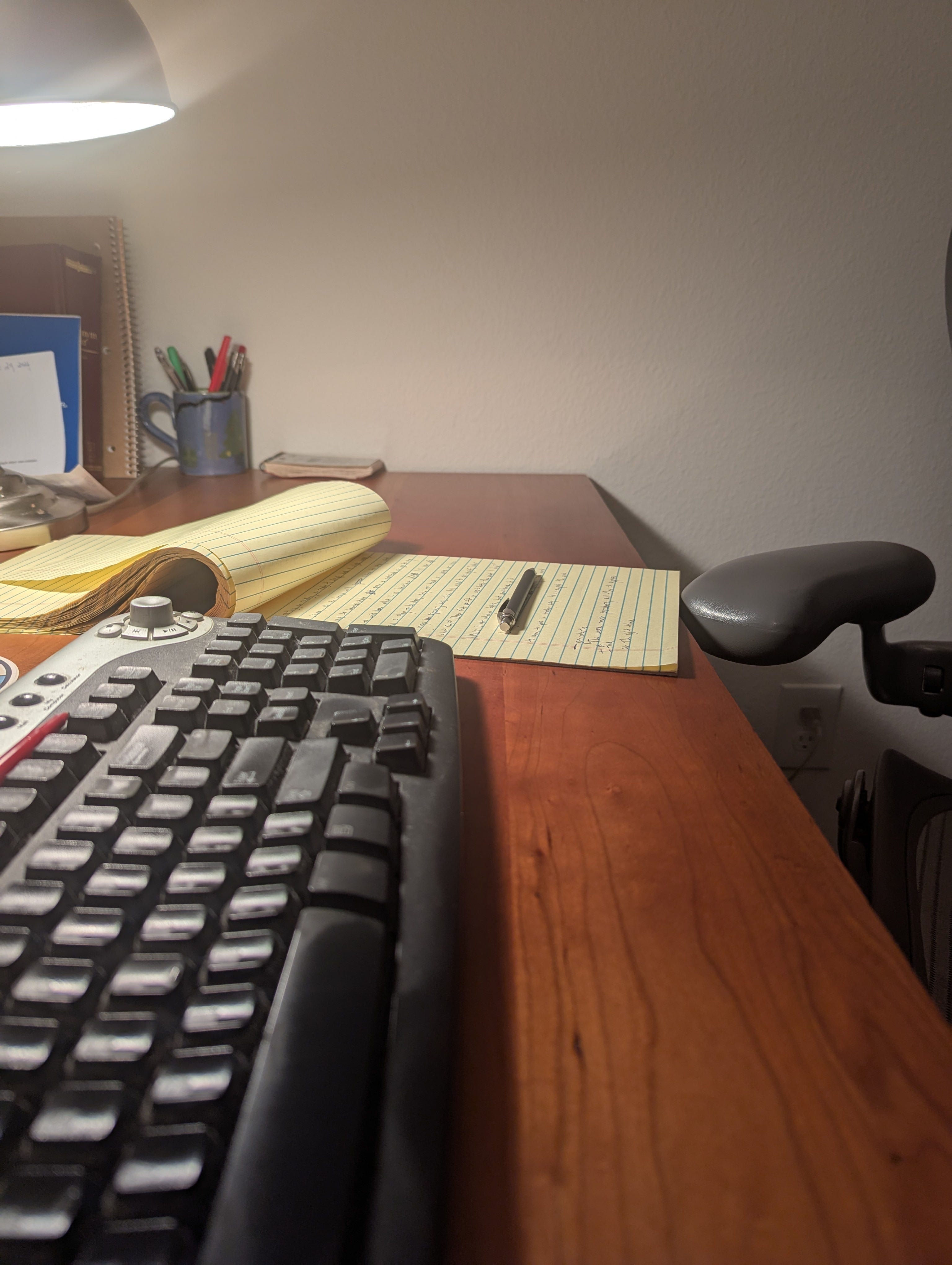
The next step after the legal pad draft is to key in the text. I use a Dell desktop with a Dell wireless keyboard that’s about 30 years old. Desktops are renewed every five or six years, but this keyboard has been a workhorse. Revisions can happen to the text at this stage, too. I might be searching for a certain word or phrase, and I’ll fix it; or sometimes I don’t want to get stuck so just put in the text [FIX] or [MORE], easily found later with Ctrl+F.
Revision work
Printing a version of the story (or novel) is always a big deal. I have an HP printer for stories. If I’m working on a novel and need to print, I’ll usually go to a local UPS store. Single-sided printing. Versions are dated. The work starts new from here.
I read through short story pages from beginning to end of the work in progress and write on from there. Unless it’s a longer story, or a novel; and for those I’ll pick up from the point of last revision to continue. Consulting my Notes file first for any revisions to make (if I haven’t already made them at the keying in phase). My Notes file gets marked up the same way with my notation system. For example, I’ll circle a sentence and note in the margin A for p. 10, or X for p. 2.
(It helped that my early career years were spent in the publishing industry, working on manuscripts. My personal notation system uses much of what I learned then.)
The number of printed revisions I work through depends on the work. I might read through a short story completely 20 or 30 or more times to make it right. I’m reading as a reader, sure, but I’m also reading for pace of the story and the music and meaning of the words. (It’s helped me enormously that in my grade school curriculum we had lessons in sentence diagramming. I remember the nuns and their fearsome yardsticks. I loved the lessons. The aim for accuracy. The precision work needed to diagram a sentence to visualize its component parts. On paper we were architecting each sentence, to understand its meaning. That mattered. Words mattered.) For my novels, I’d guess easily double that. Read through it a hundred times? That sounds about right. Of the four novels I’ve written, I’ve read three of them backwards, sentence by sentence, to get a better feel for their structure and rhythm and story, and make necessary revisions. So, forward and backward, I comb through the text to revise the feeling the words give on the page. I don’t usually read my work out loud, but I sometimes will in certain passages just to hear the sounds of the words forming the picture in my head. I see my work in my head as much as I’m writing it on the page, and I want readers to “see” my work in their minds, too. See it and hear it and taste it and smell it and feel it. This living thing.
Living with the work, and waiting
There is a part of the work that is not in the process of the work, but simply happens. So in a way it is part of the process. The more I work in the story, the more the story works in me. Countless times I’ll be away from the desk, resting, or reading, or trying to sleep, and a single word, or a scene, or an image will come to me, and I’ll need to immediately open a notebook or go to my desk to write down what it is. Sometimes I’ll even believe a story to be done, only to have a word or scene or image appear; and then I’ll need to ask myself, “What about that? Does that fit or work better than what I had before?” Newer isn’t always better, but sometimes it is.
Living with the work is part of the work, and sometimes the story comes looking for me. The work must percolate. Then it can appear.
What it’s all for
Writing fiction creates a new world, and the work of the fiction writer is to create such a world where the reader wants to be, and live. Every writer eventually discovers a process that is uniquely their own. This one happens to be mine.
If something here helps you find your own way to the work, then this essay has done its job.
Welcome.