Why (I) Write

Later in my life, I found myself in a dark place I hadn’t expected. I knew I needed to write my way out of it.
These essays are my attempt to understand why I write, and why writing has been necessary for my life.
I first started to write seriously the week after I was discharged from the mental health hospital after my fifth and final failed suicide attempt. You might guess that I would have picked up a notebook and started writing to pour my heart and soul out onto the page to describe what it was that led up to my final attempt and what it felt like to survive the overdose of Quaaludes and subsequent 6 weeks in that hospital. But I didn’t do that. In fact, that thought never even entered my mind. Instead, I bought a blank notebook (and I mean blank—it wasn’t even lined) and started writing stories. I was 19 years old.
I have that notebook still and could dig it out to see what I actually wrote. But instead I’ll recall what I can from simply memory that I wrote simple stories about whatever entered my mind. There was a story about a young man who stayed in bed so much that he eventually sank into the mattress and disappeared into another world underneath. There was a story about three friends driving in a car all night long and never reaching their destination. And on and on. They were pretty bad, Twilight Zone-Stephen King kind of crap stories that deserve to stay buried in a box in a garage.
And those stories—writing those stories—the act of putting pen to paper to set words in sequence to build a world in my mind—that was the beginning of the discovery for me of my life’s work. My passion and calling. My reason for being. And it was just this: Writing made me feel alive, like nothing else. And it made me want to live.
It hadn’t yet occurred to me to want to type up my stories and revise them in preparation for submission to magazines for consideration of publication. I think it hadn’t occurred to me because that wasn’t important to me. I mean: it didn’t matter to me. What mattered to me (and what still matters to me most) is the act and process of writing. Of getting out what’s inside. Inside out. Somehow, in some shape. To see what I think.
So I began with short stories, and as my English studies progressed I tried my hand at poetry. In poems I discovered the way to mine every word for its elemental meaning. I did not yet know what I wanted to do with my life, but I knew it had to be something with words. My love and need for words and writing was what drove me then. Still does.
Early on in my studies I had an inkling of a thought that I could write longer forms. The “Big One.” A novel. I remember reading Kurt Vonnegut, Jr. at the time, one of America’s most celebrated novelists; how he wrote or said in an interview that his experience in World War 2 was so traumatizing that he needed 20 years’ distance from it (a “helicopter view” of it, he said) in order to write about it. The distance is what was required for him to write about events that would eventually be found in his novel Slaughterhouse 5. I kept that idea of the necessary distance with me about my own trauma and how I might be able to eventually write about it in my own work. To help me make some sense of it. If that were possible.
I was 27 years old (or so) when I was accepted to two different MFA programs in creative writing, in Utah and Pittsburgh, based on (if I remember correctly, 25 pages of fiction). Both were fine programs, and it was my dream to go, but I was already in debt from undergraduate school, I had a one-year-old son, and my wife was not supportive of my work. I could have left them; I did consider it; in the end I wrote polite letters (yes, letters! Pre-internet days!) declining admission to both programs because I chose not to abandon my wife and young son because I thought it would destroy them.
So instead I destroyed myself. A part of myself.
I let go of writing to focus on my family and provide for them as I moved up my chosen career ladder in publishing and communications and, later, the internet. Early on I tried to keep writing short stories, but even that wasn’t sustainable. I gave up everything for my family, except journaling. Journaling gave me an outlet to write. And write I did. Over 16 years I wrote nearly 1 million words. But it was not enough. It was preparation.
Around 18 years after my release from the mental hospital I began to work on what would become my first novel, There Are Reasons Noah Packed No Clothes.
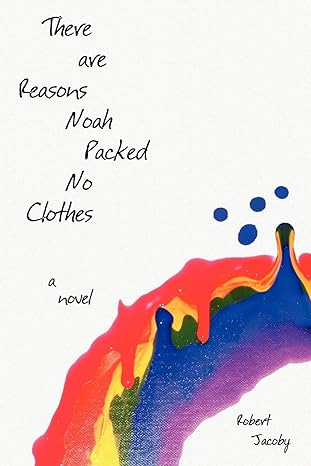
It’s a good first novel. At the time I finished it I thought it was a great novel, of course. The Great American Novel. Fair warning: It’s a fictionalized account of my experiences in the mental hospital and what it meant to me. So it’s not for everyone.
After completing it I didn’t know what to do to get it published. Through sheer endurance and persistence and will, I found a great editor. She was an immense help in guiding me through the revision and submission process. But after a hundred or so query letters and workshops and contest submissions—all with no responses or no thanks or it’s not right for me’s—I decided that it deserved an audience, no matter how small, so I self-published it.
It took me awhile to realize that it’s not for everyone. Not only because of the subject matter but also because of the way I write. So if you buy it and read it and don’t like it, that’s OK. I’ll understand.
I didn’t write to become a writer. I wrote because I needed to live.
What followed was journaling—the private work that carried me forward when little else could.