Why (I) Write. Part 7. Audience.

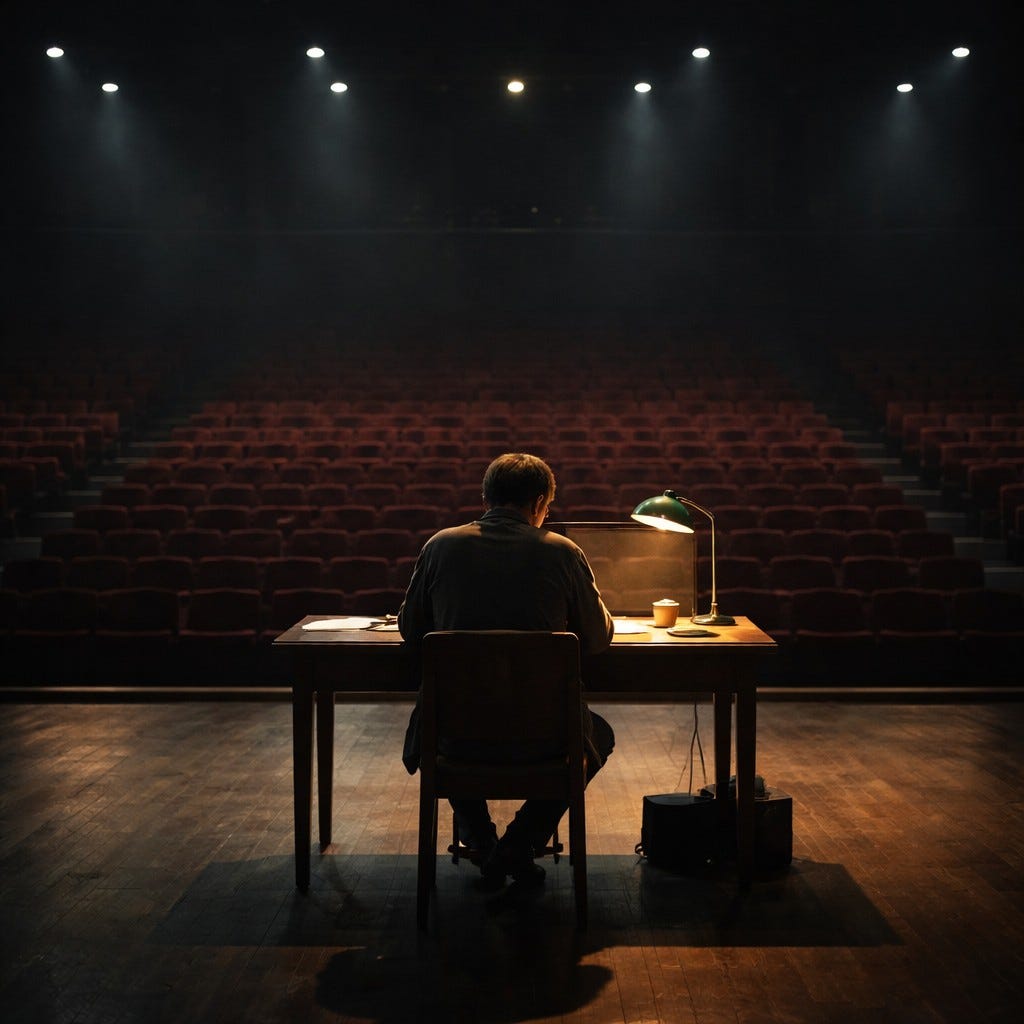
Up to this point in these essays I’ve written about the different forms my writing life has taken: journals, novels, poems, nonfiction, short stories and flash fiction. But there is another question that eventually presses in on every writer, whether he wants it to or not.
Who is it all for?
I don’t write for an audience because I don’t have one. Not really. I have readers. Occasional readers. And that’s OK. Because I don’t write for other people, to please other people. I write to please me, to satisfy my need to express myself.
Any writer who tells you he doesn’t write for readers is a liar. I don’t write for readers because I have no audience, I have said. I write to satisfy my need to get what’s inside out. What form that takes may depend on what season I am in; I mean, what project I am currently engaged with.
The audience (the readers) might vary for a novel or a short story or flash fiction piece or works of nonfiction or poetry or even journaling, if you choose to share those thoughts. I won’t touch on screenwriting or playwriting because I have no experience with those forms of writing (yet) and, more importantly, that type of writing is meant to be played before an audience anyway. The audience is built-in.
Because writing is a singular, lonesome, isolating act, the writer may not have any audience in mind at all as he works. The work of the writer is the work before the writer, at the desk, while sitting, while walking, while driving down the road and needing to pull over to pull pen and pad out to jot down that sentence, that phrase, that word, that scene, so it won’t get away, because it might make all the difference in the world, in the world the writer’s currently creating. There is no audience there at the desk, on the walk, in the car. Life is happening; life is being lived; life is being observed and felt and touched and tasted and heard.
So the first and most vital audience is necessarily you, the writer, and you alone. And when you write do you like what you write? Do you like what you hear as you read the words aloud or as they sound in the bell of your head? Do they resonate? Do they matter? Because if they don’t matter to you, first, they won’t matter to anyone else, later. The energy of your life should be in the words you put to paper so that somehow, someway, someone (a reader, an audience) may gain something from them.
Purposefully, then, a writer can choose audience. Or not. Many writers have taken this path of not, notably Gerard Manley Hopkins and Emily Dickinson. Such writers prove the point that a writer needs no audience to write, to work at the craft, to love the work for the works’ sake and satisfaction. To express oneself is to live, and to live is to be expressive. This is a joy for joys’ own sake, simply.
Now, audience (the thought of one, the threat of one) can ruin a writer, too, as it did with Truman Capote. Or audience might turn a writer into a machine, as it’s done to Stephen King and Lee Child, the guy who churns out all those Jack Reacher books. I think it would be extraordinarily difficult to avoid the quagmire of popularity, the idol of recognition. That’s why I’m happy here in my near-invisible writing life. Or should I say “satisfied”? Because we’re always pursuing happiness, aren’t we, on our individual treadmills. But satisfaction is different. The artist can be satisfied with the work, within the work, and that work done well, because he sees and senses his value, his growth, his life, through the work. It’s the art of life.
This essay is part of an ongoing reflection on writing. Earlier pieces in the series include:
Thank you for eloquently articulating this. Perfect timing--I have been working with a writing coach to review my WIP memoir. At times I've felt a combination of annoyance and frustration when asked to keep the reader in mind and add in more back story or expand more. Some feedback is useful, but overall I keep thinking it's my story, take it or leave it. My primary purpose in writing it was to process cultural adjustment experiences with grief & loss woven into it. Had to push back at one point and say no, I am not muting my innate NY sarcasm and insertion of comedy -- I refuse to rewrite everything from a heavy emotional space. I purposely included short vignettes--the title includes the word 'Postcards,' so savvy readers should understand...And if the reader can't keep up with the pace and tone change, between irreverent humor and sharing grief, so be it. Sometimes working through grief requires a sense of humor! Thankfully I am self-publishing, so I get the last & final word on what is released. Appreciate reading your perspective here!!