Why (I) Write. Part 3. The Novel.

“I write because I enjoy finding out what’s going to happen in my stories.”
--Journal entry, May 16, 2025
The idea for a novel began percolating in my mind soon after I was discharged from the psychiatric hospital. It was May, or June, 1982, I think. I had no idea how to write a novel, so I threw myself into short stories. I wrote and I wrote and I wrote and I wrote. One after the other after the other after the other. And it was all crap. Science-fictiony, Twilight Zone-ish stuff. In a few years and after much reading of serious writers (Flannery O’Connor, Joseph Conrad), I felt and thought myself ready to try my hand at “serious fiction.” The first short story I wrote won a contest at Kent State University, and so I proved to myself I was “a real writer.”
Years went by, life went on taking me into its flow of marriage and family and children and those responsibilities. I had journaling as my constant companion, so I spent my writing craft and energies there. Always in the background, or in a corner, there hunched the novel, simply sitting and waiting for me to come to it. What was I going to do about it?
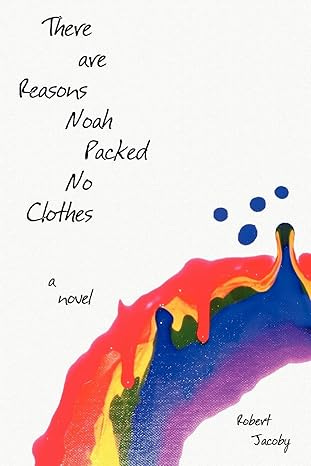
Around the turn of the century I felt enough of my life had slipped by without my noticing that I finally had to do something about it. That “something” was the beginning of my work that would become my first novel, There Are Reasons Noah Packed No Clothes. It’s a fictionalized account of my stay at the psychiatric hospital after my final, failed suicide attempt. I know that experience there had to be my first novel because of the way it shaped me and informed me of who I was. Am. In order to own it I had to write it, and to write it I had to revisit it. That trauma, that pain, that confusion, that mess. I needed to dig back in order to dig myself out. (At least, that was my vague notion; I didn’t realize this at the time; at the time I only knew I had to express myself; get the inside out.)
The wife (now ex-wife) didn’t like that, or appreciate it. We were always at odds, over any little thing and any way to live. I wrote whenever and wherever I could. Mornings before heading out to the job, at lunch at my desk at the job, evenings at home when I could, which wasn’t too often, not with a wife and three children under the age of 12.
The discipline of writing the novel solidified when I moved out of the house and into a rented room. I remember answering ads and taking tours of places I could live and eyeing them carefully for a place I could work, undisturbed, mornings before the job.
I found a place that had a room and a nook with a desk and made sure I could use that space for my work. So every morning there I was.
And I would write. Boy would I write.
I remember working at that desk every morning, then tearing myself away from it to hop in the car to get to the train station, carrying the work with me in my writing bag, and then continuing the work on the 30-minute train ride. Sometimes I was so engrossed I’d carry the manuscript or yellow legal pad with me outside the train at my stop and sit there and finish the sentences or scenes I was working on.
I write long-hand first, on yellow legal pads. I write on every other line so that there’s space in between to make revisions as I write. At the top left I tag each page YP1, YP2, and so on, and I circle it, so that if I need to I can refer back later for insertions, like A for YP27. This notation system developed over years.
After this first draft I key in the text, and so there’s another opportunity for revisions here.
After these inputs there’s the printing out of manuscript pages and the reading and revising. So that after the first 50 or 100 pages of the novel are written I will have read and revised those pages dozens of times.
The story of my first novel was trauma, and it was traumatizing to revisit it every day, every hour. It never left me. It became part of me, of who and what I was. In a sense, me trying to recreate my experiences in words recreated them in me. And, in a sense, those words on the page, that world I was making, became more real to me than the outside world.
I’ve read about this phenomenon, and when I first read about a writer claiming this I thought, That’s odd, that’s really disturbing, how could he say and believe something like that?
But I found it to be true, for myself. It wasn’t simply the weight of the pages in my writing bag, or the small notebook I kept in my shirt pocket always with my pen, ready to write down any observation, any loose word or sentence from a stranger on the street. It was the weight of the new world I carried within me that was struggling to form within me and be expressed, even as I was developing it. (And to compare this work of writing a novel to the birthing process is one of the most monstrous and debilitating lies ever concocted. It’s actually idiotic and belittles the novelist. Because the artistic process of what a serious novelist experiences during the work of his novel has nothing to do with the organic process of childbirth.) It was the “show don’t tell” admonition every serious fiction writer faces. It was the reaching, the always reaching, the constant compulsion, to dig levels deeper to discover new words and new phrases and new ways to create a world in words in which a reader could live. I wanted to make a world that seemed more real to the reader than the one he saw outside his window.
At its best, the novel is the only form of art that can show an entire new world to a person.
My second novel, Dusk and Ember, explored another trauma in my life: the aimlessness of youth and all its inherent danger.

Those are the two that are published. And as I’ve said before, if you read them and don’t like them, that’s OK. I know they’re not for everyone. Not in substance or style.
I have two unpublished novels now, both complete, rejected by dozens and dozens of literary agents. Titled One Day in the Life of Daniel Farr and its sequel One Year in the Life of Daniel Farr. The first about a middle-aged man’s awakening from his life slumber (after he’s fired from his job for browsing internet porn and goes wandering the city with two of his also-fired coworkers); the second about the same man as he learns what the cost of his freedom is after his divorce.
Trauma doesn’t leave. It finds new places to live, and sometimes those places become story.
“What gives my mind real peace is writing a fine sentence.”
--From a letter to my ex-wife, April 8, 2003
If you like this essay, you might also enjoy Why (I) Write and Why (I) Write. Part 2. Journaling. and Why (I) Write. Part 4. Poetry.