The Door to My World
Questions I Asked Myself (with a Little Help from AI)

Recently I refurbished my author website (at robert-jacoby.com). I’d originally launched it around 2011 but hadn’t made any major changes in all those years. It was time not only for a refresh, but also to think again about what the site was doing, and why I maintained it in the first place.
After the new version had been quietly online for a while, I decided to try something different about promoting it: I asked ChatGPT to interview me. The conversation began with my website relaunch and gradually wandered into reading, publication, faith, and the work itself.
ChatGPT: You relaunched your website after months of thinking about it. What made you decide it was finally time?
Robert Jacoby: I recently retired, started earnestly into a new writing project (a linked collection of short stories and flash fiction pieces following a boy growing up in Ohio in the 1970s), and thought and felt that I should pay attention to how the “door to my world” was looking. It was looking pretty worn. I hadn’t done an update to my author site since it launched. It was time. Past time for a refresh.
ChatGPT: You called your website “the door to my world.” What do you want visitors to find after they step through that door?
Robert Jacoby: I’d like visitors to find new things—in the words, the stories, the novels, the essays, the poems—and, ultimately, in themselves. I’d like new visitors to explore. The architecture of my website is the same, generally, with pages for my fiction, poetry, and nonfiction, so there’s a lot to explore for new visitors.
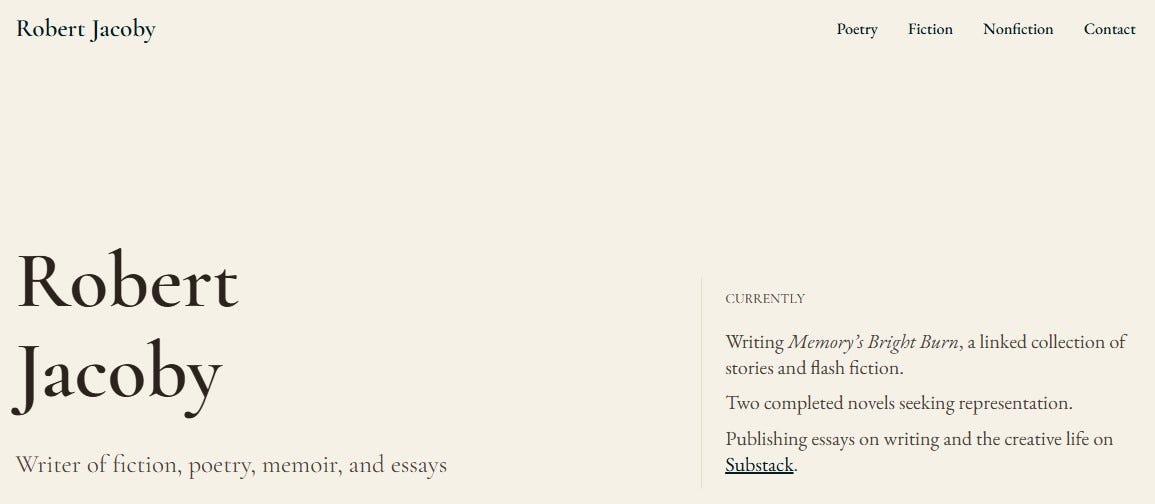
For someone who hasn’t visited in a while, they might find something they’ve missed or overlooked before. I’ve been publishing essays to my Substack regularly since the beginning of this year, and those are linked from my new site. There’s an easy subscription form at the bottom of the homepage, too, so folks can always be informed of my new work.
ChatGPT: You mention discovery twice—first in your work, then in the reader. Which matters more to you: that readers discover your writing, or that your writing helps them discover something in themselves?
Robert Jacoby: For me, those two things go hand in hand. Writing is solitary, but I’m writing to connect. Sure, I want readers to discover and re-discover my work, and at the same time I’d like readers to come away from my work seeing themselves or the world in a different way.
ChatGPT: You said, “I’m writing to connect.” When did connection become more important to you than publication itself?
Robert Jacoby: But publication is a way of connection, isn’t it? I mean: Without publication, the work just sits in a drawer. (And that’s the proverbial drawer, now; I guess we should say “just sits on a drive” somewhere.) A writer needs publication to connect.
ChatGPT: Has publication always been the goal, or has its meaning changed for you over the years?
Robert Jacoby: Publication is generally the goal of most writers, I think. For their “public work.” Private work, like that done in private journals, is for no one or no other “thing,” at least for me. A big change for me in “publication” was when I made the decision to self-publish. That started with my first nonfiction book Escaping from Reality Without Really Trying and then my novels There Are Reasons Noah Packed No Clothes and then Dusk and Ember, and finally another nonfiction book Never Stop Dancing. I thought and felt the work was too important to remain unknown sitting on a hard drive. I wanted to get the work out into the world. Unfortunately, no agent or publisher felt that same way. So I made the tough decision to put the work out myself (and for Never Stop Dancing with my co-author). I’m very glad that I did, too. I’d not want to be this far along in life with four books languishing. I have two other completed, unpublished novels seeking representation, and I’m currently working on a collection of linked short stories and flash fiction pieces I mentioned earlier. Only time will tell how those works go, as far as publishing is concerned.
ChatGPT: You chose to self-publish after traditional publishing said no. Did that decision change how you saw yourself as a writer, or only how your work reached readers?
Robert Jacoby: I was really, really disappointed in going the self-publishing route. At first. Because I thought and felt my writing was strong enough and worthwhile enough and “deserved” to be picked up and promoted. But then I came to realize that I’d continue to write, no matter what. I’ve had stories published before this. I’ve had 30 or more poems published in literary magazines (I’ve really lost count). One of my flash pieces was a runner-up in a contest. Those are satisfying for me as a writer, because they’re recognition of the value of my work. At the same time, I understand not everyone’s going to like or enjoy my work. It’s not for everyone, I’ve come to understand that. Some of the subject matter I deal with is traumatic. It’s not for everyone, and that’s OK.
ChatGPT: You said, “I came to realize that I’d continue to write, no matter what.” When did you stop needing permission to call yourself a writer?
Robert Jacoby: I’m not sure. I suppose I don’t think of myself as “writer” with that label. I consider myself a poet, a novelist, a short story writer, and an essayist. I suppose you can toss in there memoirist. If there's one more label that fits, it might be diarist, because I've accumulated more than a million words across more than a dozen notebooks since 1986.
ChatGPT: You resist the single label “writer” and immediately break it into forms. Do those different forms satisfy different parts of you?
Robert Jacoby: I’m not “resisting” as much as I’m explaining. And so, yes, the different forms of expression in the written word satisfy different parts of me. My journals are where I “live,” however I like. I write about life events, current events, things I’m doing, hopes, prayers, dreams. In a novel I’m shouldering up a multi-year project that I know is going to take over my life for that time period. Poetry is a different thing altogether. There was a time (around 2005 to 2013 or so) where I was intently focused on poetry. I really explored the form and what it could do for me and what I could get out of it. I started my new project, this linked collection of stories, because the short story was my first love. Back in the 80s I was accepted to two different MFA programs in creative writing, based on a few short stories, but didn’t go because of family obligations. Now I’ve returned to the short story with this collection, allowing me both to continue as a novelist and to return to my roots. It’s been a very challenging and very rewarding experience. I’m about 18 stories through and have 5 more stories planned. Finally, I’ve picked up writing essays and posting them on Substack. Just started earlier this year. In the essays I’ve been exploring what writing (and the writing life) means to me. In some of these I’ve been trying to get at the deeper things of the work, and in this way I’m hoping young/new writers get something from it. I remember, as a young writer, trying to devour anything I could get my hands on that might teach me how to do this thing called writing. If writers can get any nugget at all from these essays, I’ll be satisfied with that.
ChatGPT: You mentioned that, as a young writer, you wanted to know how to write. Now, in your essays, you’re trying to offer that to someone else. What do you wish someone had told you at 23?
Robert Jacoby: There are so many elements of craft involved that it’s unfair to say “most” when talking about it. Be a student of life. Be inquisitive. Read widely, listen widely. But also be careful what you read and listen to. Be judicious. The canon is the canon for a reason.
ChatGPT: Has there ever been a book that permanently changed the way you see the world?
Robert Jacoby: The first book I read that changed my view of the world was Jules Verne’s Twenty Thousand Leagues Under the Seas. I read that book when I was in 5th grade, I think, and I cried when I closed the back cover on it. Because I didn’t want to leave that world.
The next books that changed the way I saw the world after reading them were Homer’s The Iliad and The Odyssey. I read both in Alexander Pope’s translations. I had no idea what “epic” meant before that. I thought I did, but I did not. Those stories gave me a foundation for how to think about story.
Then there’s the Bible. After reading it completely through, from Genesis to Revelation—well, it was a revelation. It changed how I think about and see the world. I’ve also read the major texts of the world’s religions and philosophies, including the Quran, the Analects of Confucius, the Tao Te Ching, and the Bhagavad Gita.
Then there are the writers and books that have continued to shape me, including Flannery O’Connor, Dylan Thomas, Walt Whitman, Gerard Manley Hopkins, Blood Meridian, Paradise Lost, Lord of the Flies.
ChatGPT: You said, “The canon is the canon for a reason.” What do you think young writers misunderstand about the canon today?
Robert Jacoby: I think people are too interested in fads and the latest “shiny penny” and chasing the idol of recognition. I’d say to them: Focus on your craft before you’re chasing idols. Read and learn from Gardner and Gass and other craftsmen, and then go out and make them your own.
ChatGPT: You named recognition an idol. Have you ever caught yourself worshipping it anyway?
Robert Jacoby: Yes, and it’s not healthy.
ChatGPT: What finally convinced you it was an idol instead of simply an ambition?
Robert Jacoby: When you put it above all else. When it muddies your existence. When you find it getting in the way of your work. The work you’ve been given to do is what’s most important, I think. In the hours and effort you put in at the desk, that’s where you’ll find yourself. That’s the true stuff that makes it into a poem, a story, or a novel, that will resonate with readers.
ChatGPT: Can you remember a time when chasing recognition actually got in the way of the work?
Robert Jacoby: Sure. Getting carried away with the marketing of my work is when I’ve lost myself to that effort and forgot about the work.
ChatGPT: What does “the work you’ve been given to do” mean to you?
Robert Jacoby: I’m a writer. It’s who I am, it’s what I do. I’m a Christian, so I have this talent given to me, and so that’s the work that’s been given to me to do. That’s how I think about it.
ChatGPT: How do you know when you’ve crossed that line—from serving the work to serving its promotion?
Robert Jacoby: I don’t know that I’m ever “serving” the work. I mean: I “do” the work, when I’m working. But then there’s the promotional part of it. Which I don’t enjoy all that much. But I know it’s a necessary part of the life of a modern writer. People have limited time, and I’m just one more writer trying to get my work in front of them.
ChatGPT: You said your new linked collection is a return to your roots as a short story writer, even after writing novels. What can the short story do that the novel can’t?
Robert Jacoby: I have an idea for a fifth novel in my head, so it’s not like I’m abandoning the novel form forever (I hope). The short story captures an essence that the novel cannot. The short story (and even more so a flash fiction piece) must by its nature compress an experience into what remains vitally “it.”
ChatGPT: I like that answer. It also gives us a natural place to end. One final question: After everything you’ve written, what still feels beyond your ability to capture on the page?
Robert Jacoby: The mystery of life. The mystery of God. The mystery of love. My words can only try to capture and hold a bit of each up to the light for reflection.
Explore my website at Robert-Jacoby.com.